

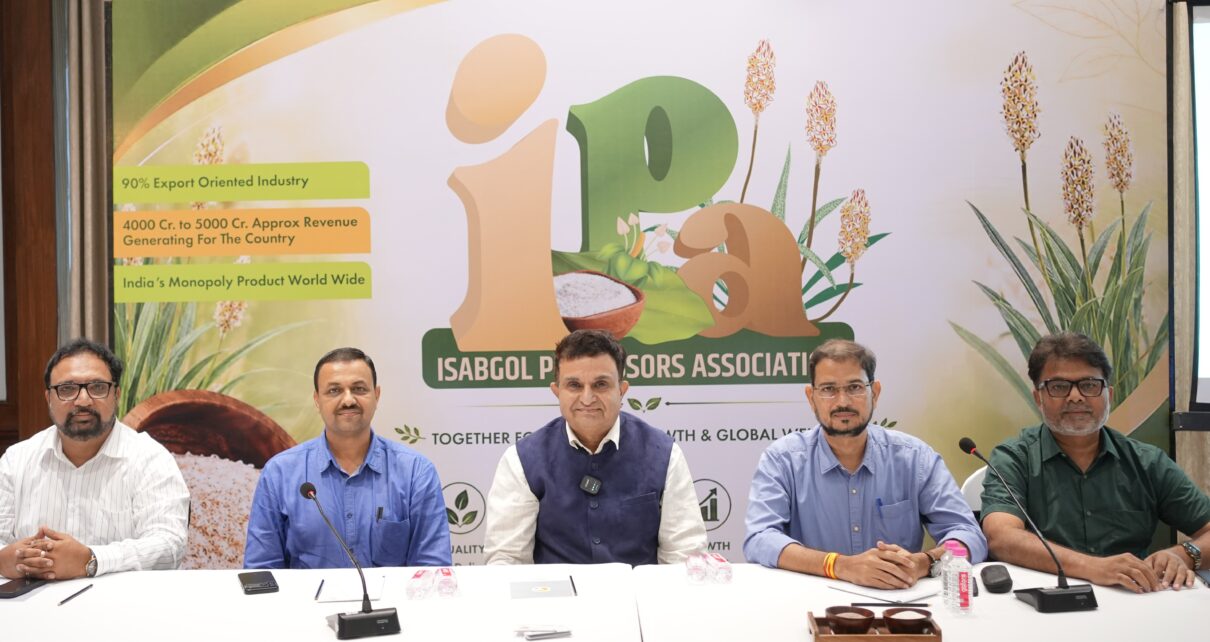
Ahmedabad, August 25, 2026: The Isabgol Processors Association (IPA) has urged the GST Council, Ministry of Finance, CBIC and Tax Research Unit (TRU) to urgently clarify the GST treatment of naturally procured Isabgol (Psyllium) seeds, as divergent interpretations by GST authorities have disrupted one of India’s key Isabgol trading and processing markets.
Whether Isabgol seeds purchased directly from farmers in their natural condition, without any intentional drying or processing, should be classified as ‘fresh’ and attract Nil GST, or be treated as ‘dried’ and attract 5% GST, particularly in light of the CBIC FAQ stating that fresh Isabgol seeds attract Nil GST while dried or frozen seeds attract 5% GST?
Gujarat and Rajasthan Take Different Views
In Gujarat, the Authority for Advance Ruling, in GUJ/GAAR/R/2026/21 dated May 29, 2026, held that Psyllium seeds supplied in their natural, raw and unprocessed form, procured directly from farmers through APMC auctions without drying, freezing, crushing or other processing, qualify as fresh Isabgol seeds and are exempt from GST.
However, recent Rajasthan rulings have taken a different view. In In Re: M/s Surendra Bucha (RAJ/AAR/2026-27/03), the Rajasthan AAR held that Isabgol seeds supplied by APMC traders to processing units attract 5% GST, reasoning that the seeds acquire a dried character through storage in dry, ventilated conditions, even without intentional drying. This directly diverges from the Gujarat ruling on similar facts.
Further Rajasthan rulings reported in August have also denied the Nil-GST exemption and held Isabgol seeds taxable at 5%, adding to the uncertainty faced by the industry.
Uncertainty Disrupting Trade
The conflicting interpretations have severely affected the movement of fresh Isabgol seeds across the major trading regions of Gujarat, Rajasthan and Madhya Pradesh. Traders are hesitant to issue invoices because of concerns over potential tax demands, interest and penalties, while farmers are finding it difficult to sell their produce and processors are facing uncertainty over raw-material supplies.
The disruption is particularly significant for Unjha, one of the country’s major Isabgol trading centres. Recent reports indicate that the GST dispute has brought trading activity to a standstill as industry stakeholders await a common tax position.
Significant Impact on an Export-Oriented Industry
Isabgol seeds are primarily used as the raw material for producing Isabgol Husk. According to the IPA, approximately 90% of finished Isabgol Husk is exported, while around 10% is sold domestically at 5% GST. Nearly 70% of annual seed procurement takes place between April and June, whereas exports continue throughout the year.
The Association said that imposing GST on naturally procured fresh seeds would also result in substantial working-capital blockage through input tax credit, particularly for an export-oriented industry where the credit would ultimately need to be utilised or refunded.
IPA Seeks One Clear National Position
Mr. Ashwin Nayak, Chairman, Isabgol Processors Association, said the industry needs a clear and uniform interpretation that can be followed by farmers, traders, processors and exporters across states.
The Association has appealed to the GST Council, Ministry of Finance, CBIC and TRU to examine the matter and issue a nationally applicable clarification on whether Isabgol seeds purchased from farmers in their natural condition and supplied to processing units without intentional or mechanical drying should be treated as fresh and therefore exempt from GST.
The IPA believes that an immediate clarification will help restore confidence in the Isabgol seed market, protect farmers, enable uniform GST compliance, prevent future tax disputes and ensure uninterrupted production and exports of Isabgol products.


