
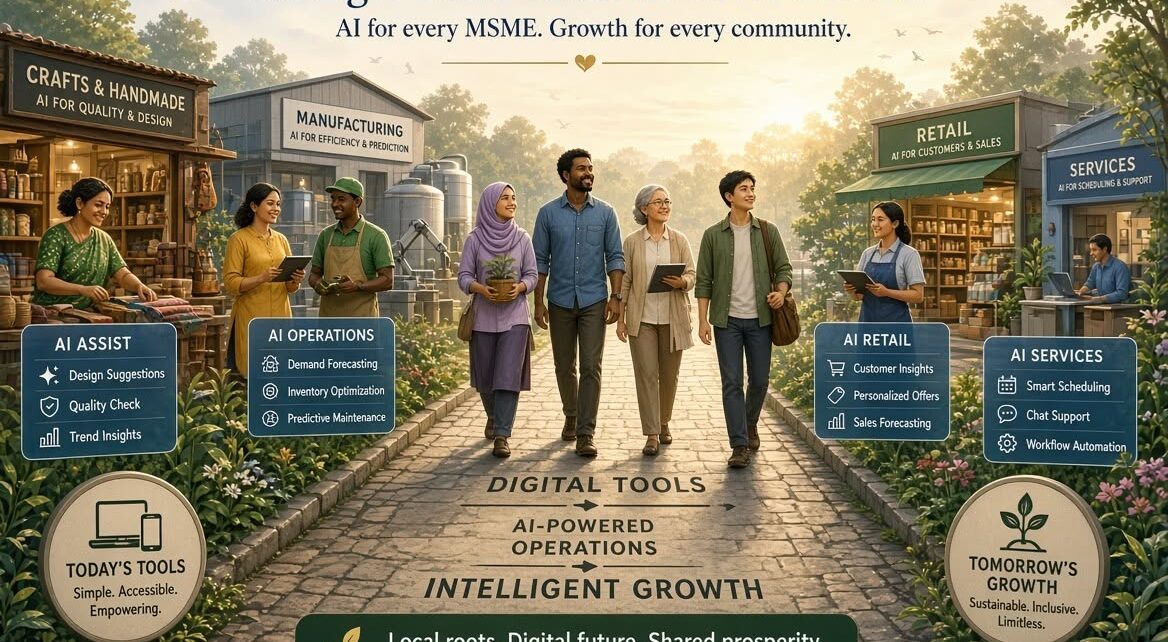
MSMEs account for 90% of businesses worldwide, provide 60–70% of employment and contribute around 50% of global GDP. As artificial intelligence rapidly enters the business world, the future of this vast segment is becoming a key measure of whether AI can deliver inclusive value. The current journey can best be described as a transition from “digital adoption to intelligent growth”—moving beyond simply becoming digital to becoming smarter in the way businesses grow.

AI Adoption Is Rising, But Growth Remains Elusive
According to available data, AI adoption among MSMEs worldwide is increasing rapidly. An OECD survey published in 2026, covering more than 2,000 SMEs across 12 countries, found that 61% reported using at least one AI application. In Singapore, AI adoption among SMEs increased from 4.2% in 2023 to 14.5% in 2026. In mainland China, around 42% of micro and small enterprises have invested in AI technologies.
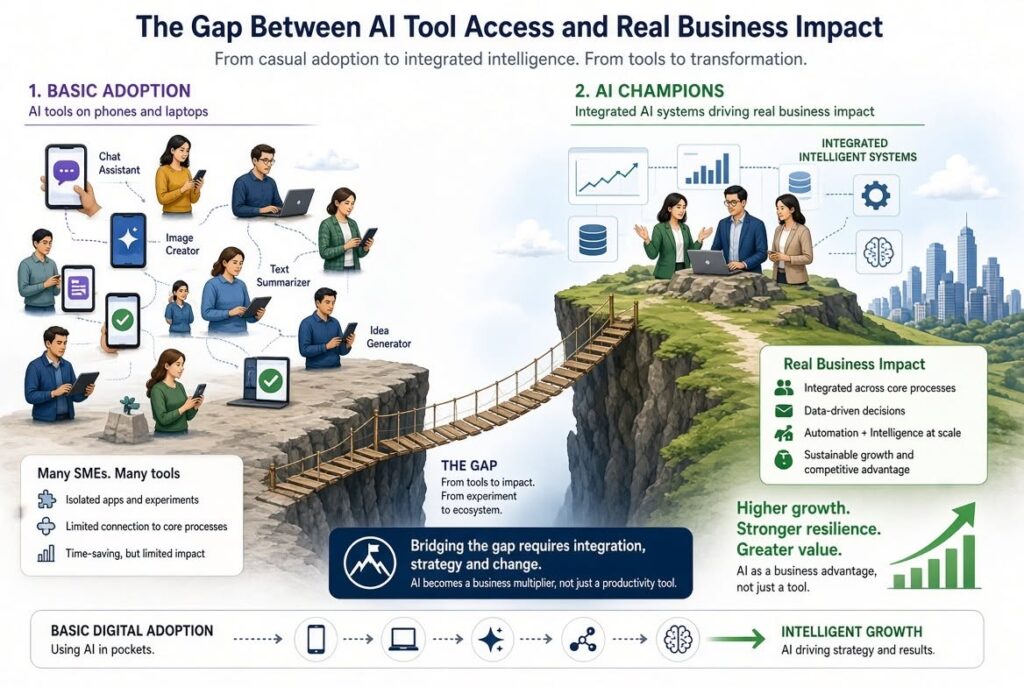
Yet there remains a significant gap between access and proficiency. The OECD report highlights a serious reality: 76% of SMEs using AI are still at the “AI beginner” stage, applying tools only to individual, simple tasks. Only 3.6% qualify as “AI champions.” Even more strikingly, 44% reported that they had experienced no tangible benefits from AI.

In other words, many businesses have embraced digital adoption, but intelligent growth remains out of reach.
This “value-conversion challenge” is not fundamentally a technology problem. An expert working on AI businesses in France noted that employees in the United States and Europe may use similar tools, yet 5.2% of U.S. working hours are associated with AI, compared with less than one-third of that level in Germany, France and Italy. The difference, the expert argued, is a deployment problem rather than a technology problem.
Different Countries, Different Strategies: From Subsidies to Real-World Depth
To address this challenge, different economies are adopting very different strategies on the path from digital adoption to intelligent growth.
Singapore has chosen a structured policy mix. Its National AI Impact Programme, launched in 2026, has clear targets: helping 10,000 businesses adopt AI over three years and training 100,000 “bilingual” workers who understand both their industries and AI. Its retail digitalisation programme focuses on upgrading the entire chain—from the “front of the store” and warehouse operations to the back office—with more than 90,000 SMEs involved.
Germany has adopted a more cautious and practical approach. German SMEs commonly use architectures based on “small models + data middleware + knowledge bases + APIs,” focusing on specific processes and applications. Localised, high-quality data is used to deliver targeted improvements. At the policy level, Germany has allocated €5.5 billion across the AI value chain, with 30% dedicated to empowering SMEs, and has established 15 AI excellence centres offering free technical diagnostics and computing support.
South Korea has outlined four key policies at the APEC SME Ministerial Meeting: AI transformation in manufacturing; AI transformation for local and small businesses; support for AI startups; and the diffusion and expansion of AI. These initiatives include building an integrated AI platform for SMEs and opening up public data.
India’s initiatives are also noteworthy. The government-approved IndiaAI Mission has a budget of ₹10,372 crore (approximately US$1.24 billion), spread across seven pillars covering computing capacity, innovation centres, datasets platforms, application development, future skills and startup financing. The objective is to democratise the benefits of AI across all sections of society, including MSMEs.
At the grassroots level, the PM Vishwakarma scheme has brought AI-related tools to traditional artisans in Punjab, including training in product photography, branding and customer communication.
China is pursuing a “scenario-based, lightweight and inclusive” approach. Policy efforts focus on developing publicly supported foundation models and high-quality industry training datasets, while encouraging the development of lightweight applications and micro-services tailored to SME requirements. The 2026 Government Work Report continues to promote the “AI Plus” initiative, while high-tech zones in several regions are providing computing vouchers and model subsidies to help industries adopt AI in specific scenarios in a lightweight manner.
The Hidden Threat: A Major Security Gap
As countries compete to promote AI adoption, a structural risk is also building up.
The OECD report states that 22% of surveyed SMEs had experienced a digital security breach, while 14% had no cybersecurity measures and 32% had only minimal security measures.
Meanwhile, cybercriminals are already systematically using AI to strengthen attacks. By early 2025, AI-assisted phishing had reportedly accounted for more than 80% of global social-engineering activity.
For an MSME, a major security incident can be devastating. Data cited in the report indicates that the average ransom demand in ransomware attacks is around US$46,000, while 17% of affected businesses become insolvent or shut down.
As businesses concentrate resources on acquiring AI tools, security investment can often lag behind. This “attack-defence imbalance” could erase the productivity gains delivered by AI and derail the journey from digital adoption to intelligent growth.
Not Just Tools — Strategy Is Essential
The United Nations established Micro, Small and Medium-sized Enterprises Day to raise public awareness of the contribution of MSMEs to achieving the Sustainable Development Goals. In the AI era, the extent of that contribution will increasingly depend on one critical question: can SMEs close the gap between “access to tools” and “strategic integration” and complete the journey from digital adoption to intelligent growth?
The OECD survey offers an important policy insight: SMEs that apply generative AI to core business activities are more likely to report tangible business impacts. Around 39% said AI had helped them address skills gaps. For a team of 15 people, this “skills multiplier” effect can potentially be far more valuable than it might appear from the perspective of a large enterprise.
As one observer put it, “The depth gap is fundamentally a strategy gap.”
Seventy-seven percent of SMEs reportedly have no formal AI policy, while most operate an average of five AI tools without integrating them with one another. The number of tools is increasing, but organisational capability is not keeping pace. As a result, intelligent growth remains beyond reach for many businesses.
For millions of MSMEs worldwide, AI is neither a magic solution nor a luxury. It is becoming a fundamental capability that needs to be carefully integrated into organisational and management structures.
National policies are moving from “encouraging experimentation” towards “scaling adoption.” But the real test will come when subsidies end and AI tools become widely available: how many businesses will actually make the leap from “AI beginners” to “AI champions” and transform digital adoption into intelligent growth?
The answer will help determine whether economic development in the AI era moves toward greater concentration—or greater inclusion.