

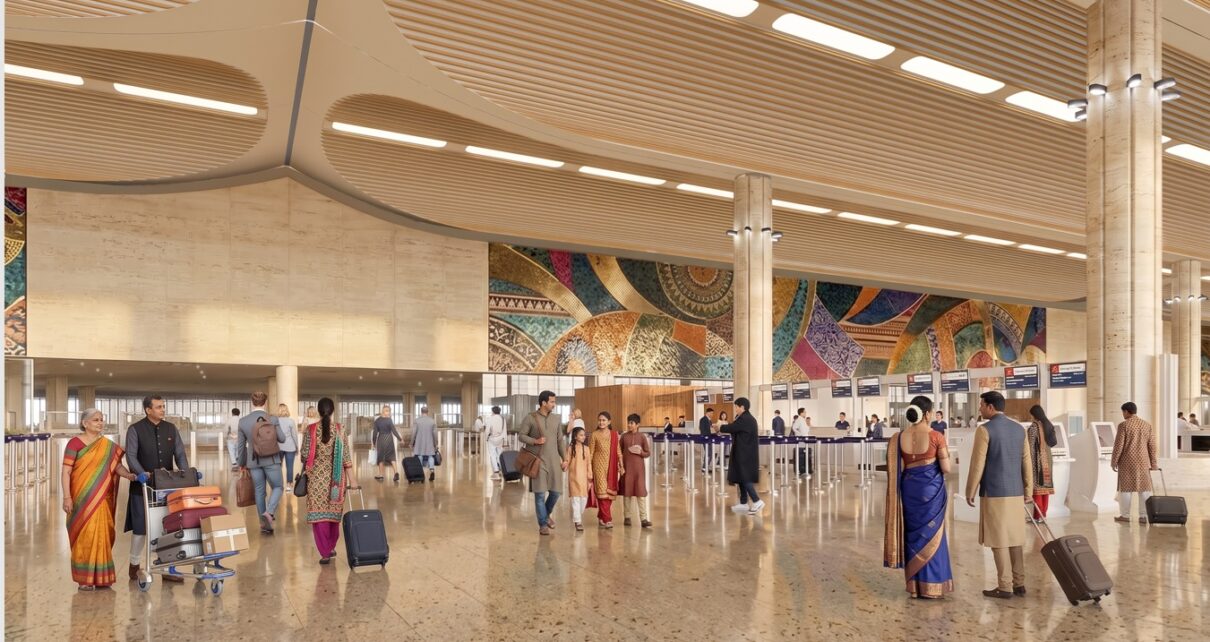
MUMBAI: Chhatrapati Shivaji Maharaj International Airport (CSMIA) has shared artistic impressions outlining its vision for the redevelopment of Terminal 1 (T1) during a meeting with the Airport Airline Operators Committee (AOC).
The visuals present a passenger-centric architectural vision for Mumbai’s future gateway, highlighting the intended character and experience of the terminal rather than serving as a definitive preview of the final design.
Commissioned in 1964, the ageing T1 facility has passed its prime. Independent audits conducted by Structwel in 2017 and IIT Bombay in 2024 highlighted serious safety and structural vulnerabilities, making the replacement of the nearly 60-year-old facility an urgent necessity for public safety.
A Passenger-Centric Architectural Vision
The artistic impressions envisage a terminal designed around passengers’ needs and Mumbai’s growing status as a commercial capital. The vision extends beyond a conventional facelift, aiming to transform the existing fragmented structure into a seamless, modern and culturally inspired gateway.
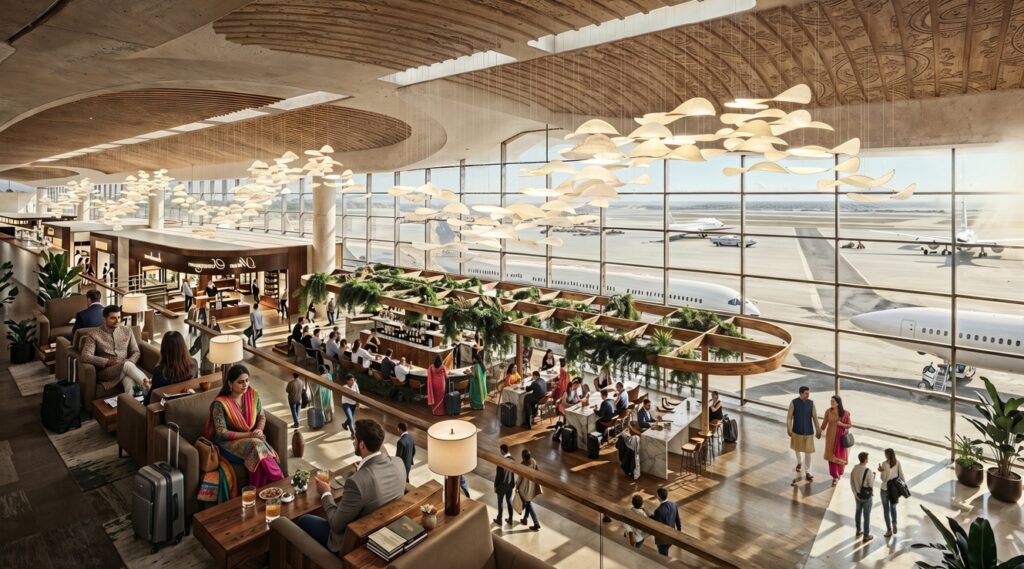
The concepts illustrate the proposed passenger experience across key areas:
- Departure Kerbside: A sweeping, soaring entrance designed to create a welcoming arrival experience.
- Check-in Hall: A vast, sunlit, column-free space featuring local art murals reflecting Mumbai’s rich cultural heritage.
- Departure Hold Area: An oasis-like environment featuring lush indoor greenery, premium lounges and expansive glass façades overlooking the runways.
- Arrival Kerbside: An open, artistic welcome featuring a signature giant flamingo sculpture celebrating Mumbai’s natural biodiversity.
Engineering for Greater Capacity and Efficiency
Alongside its architectural vision, the redevelopment plans aim to enhance passenger-handling capacity, streamline processes and improve operational efficiency.
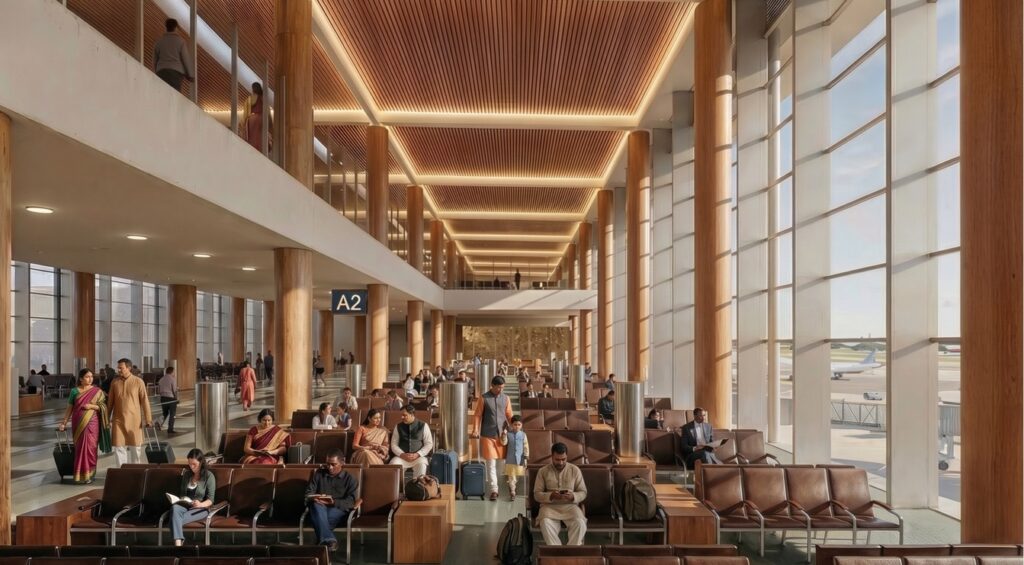
Key proposed improvements include:
- 33% increase in annual passenger capacity: From 15 million passengers per annum (mppa) to 20 mppa.
- More check-in counters: A 47% increase, from 74 to 109 counters.
- Expanded security screening: Security lanes will increase 2.5 times, with 15 passenger lanes and five transfer lanes.
- More contact stands: An increase of 3.5 times, from seven to 25, reducing dependence on remote boarding.
- Modern boarding facilities: Twelve state-of-the-art e-gates are planned to replace conventional boarding gates.
- Faster baggage collection: The number of baggage reclaim belts will more than double, from five to 11.
Phased Redevelopment to Ensure Continuity
To maintain airport operations during the redevelopment, CSMIA plans to implement a carefully phased transition strategy.
Demolition of the existing Terminal 1 is scheduled to begin in April 2027. To accommodate interim domestic passenger traffic, the expansion of the north-west pier at Terminal 2 (T2), comprising a ground-plus-three-storey structure (G+3), is planned to become operational by March 2029.
The new Terminal 1 will then be developed on the existing site, with completion targeted for December 2030. Following the planned expansion, Mumbai airport’s overall passenger-handling capacity is expected to reach 65 million passengers per annum (mppa).
A Modern Gateway Reflecting Mumbai’s Identity
The artistic impressions reflect CSMIA’s ambition to create a safer, more welcoming and distinctly Mumbai-inspired airport experience. With passenger convenience, cultural identity, operational efficiency and modern infrastructure at the heart of the proposed redevelopment, the new Terminal 1 is envisioned as a significant step towards meeting Mumbai’s future aviation needs.
Note: The architectural visuals represent the proposed vision for the redevelopment and should not be interpreted as a definitive representation of the final design.


