

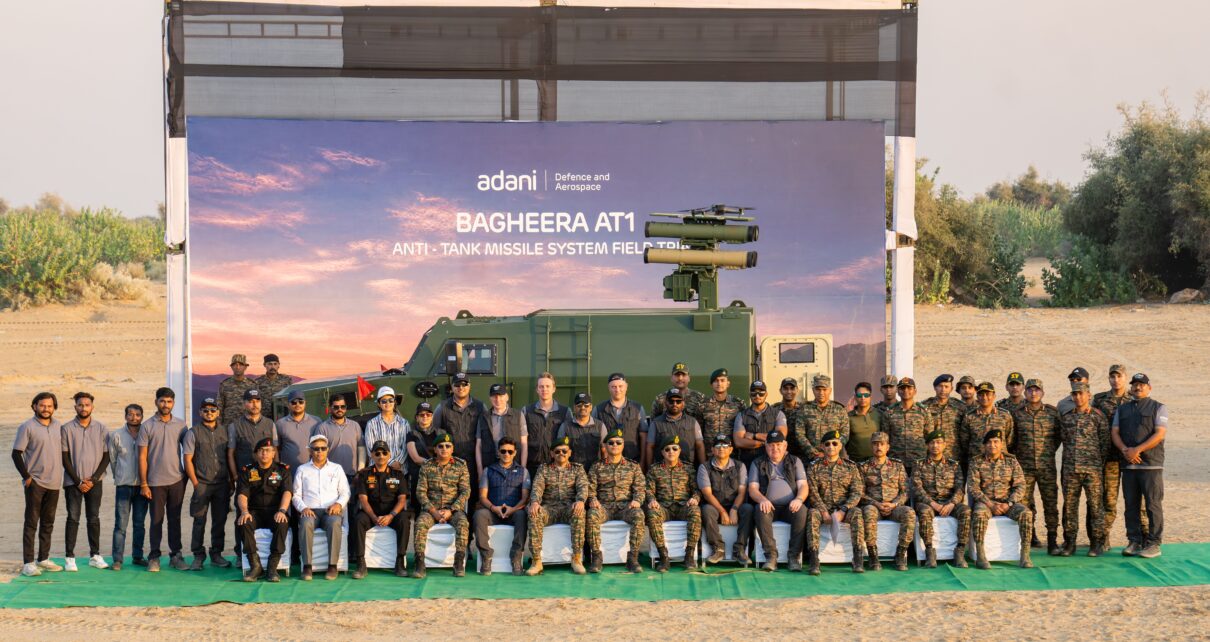
- Successful No Cost No Commitment (NCNC) demonstration at Pokhran on 20 November, witnessed by senior representatives of the Indian Army, Department of Military Affairs and Ministry of Defence (MoD).
- Anti-tank engagement range of 8 km, with the wider missile architecture capable of supporting guided engagements of up to 10 km.
- Laser beam-riding guidance, offering high resistance to electronic jamming, and a two-missile salvo on a single beam designed to defeat a tank’s active protection system.
- 18 months of design and development by Adani Defence & Aerospace to customise the complete system for Indian operational requirements.
Pokhran (Rajasthan), 21 November 2026: Adani Defence & Aerospace, the Adani Group’s flagship defence and aerospace company, successfully demonstrated Bagheera AT1, a vehicle-mounted anti-tank guided missile (ATGM) system, at the Pokhran Field Firing Ranges in Rajasthan.

The programme validated day and night engagements, a two-missile tandem firing along a single beam against a target representing an armoured vehicle, and an aerial-target engagement at an extended range. It was followed by a static display of the complete system.
The No Cost No Commitment (NCNC) demonstration at Pokhran on 20 November was witnessed by senior representatives of the Indian Army, Department of Military Affairs and Ministry of Defence (MoD).
Built for the Indian battlefield
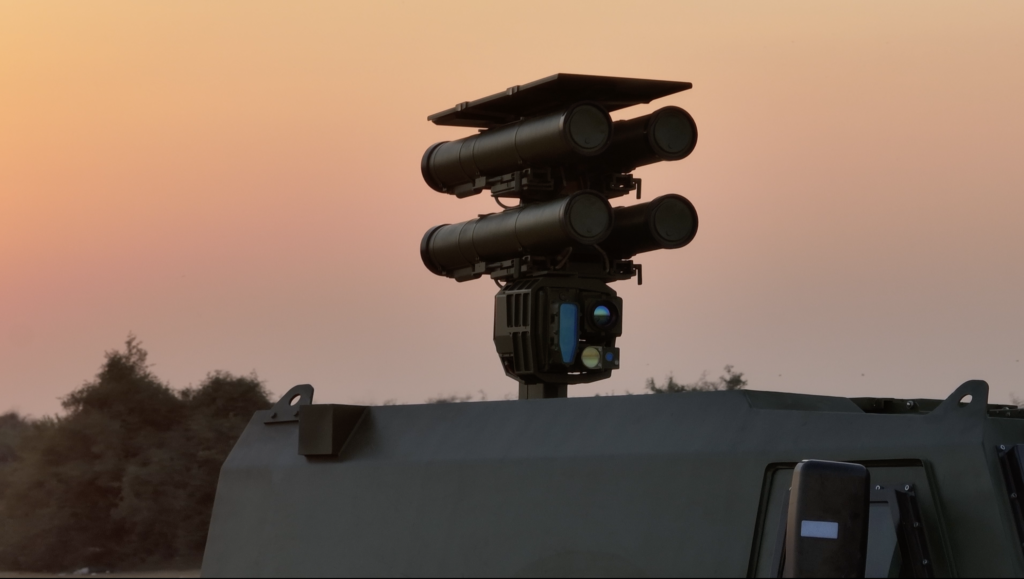
Bagheera AT1 is the outcome of 18 months of design and development, during which Adani Defence customised the missile system for Indian terrain, climate and operational requirements. The result is a complete combat system comprising the missile, automated launcher, day and night sights, mounted on an Adani Defence-designed 4×4 high-mobility armoured vehicle.
- Stand-off reach: Engages armour at up to 8 km, twice the approximately 4 km range of the land-based anti-tank missile.
- Jam-resistant guidance: The missile rides a laser beam rather than relying on a radio link, making it highly resistant to electronic jamming on a battlefield increasingly shaped by drones and electronic warfare.
- Defeats active protection: Two missiles can be fired in quick succession along the same beam at a single target. The first engages the tank’s Active Protection System (APS), while the second is designed to penetrate its defences.
- Sustained firepower: 4 ready-to-fire missiles on the automated launcher and 8 reloads onboard, providing a total capacity of 12 missiles per vehicle.
- Day and night: Integrated day television and thermal-imaging sights with automated target tracking.
- Shoot and move: The crew engages from cover and relocates quickly to reduce exposure to enemy fire.
- Beyond armour: The system can also engage aerial targets at extended range.
Advancing India’s Anti-Tank Capabilities
India’s requirement for modern anti-tank guided missiles remains substantial, with reported gaps in the ATGM inventory underscoring the need for continued modernisation.
The in-service backbone remains second-generation Milan-2T and Konkurs-M, with Spike missiles subsequently inducted to address immediate operational requirements. India is also progressing with the acquisition of Javelin systems.
Recent conflicts have underscored the importance of range and mobility in armoured engagements. Bagheera AT1 offers the Army an additional long-range, mobile ground capability alongside man-portable and helicopter-launched missiles.
Private industry closing capability gaps
India’s defence production reached a record ₹1.78 lakh crore in FY 2025-26. The private sector’s share rose to 24 per cent, or about ₹42,000 crore, from 22 per cent a year earlier, while defence exports hit a record ₹38,424 crore.
Bagheera AT1 demonstrates the growing role of India’s private sector in developing, integrating and delivering advanced defence systems tailored to the operational requirements of Armed Forces. Adani Defence & Aerospace has undertaken the development, integration and testing of a complete combat system, providing the Armed Forces with a system for evaluation.
The programme builds lasting national capacity to integrate, manufacture, support and progressively indigenise advanced anti-armour systems, reducing dependence on emergency imports.
About Adani Defence & Aerospace
Adani Defence & Aerospace, part of the Adani Group, is India’s largest integrated private defence and aerospace company, building critical capabilities across land, air and sea. The company focuses on the design, development, manufacturing and sustainment of a wide range of defence and aerospace platforms and systems, including airborne surveillance and AEW&C, unmanned systems, arms and ammunition, electronic warfare and avionics, and advanced munition solutions.
With a strong emphasis on indigenous lifecycle sustainment, MRO and aviation training, Adani Defence is developing a resilient defence industrial ecosystem through strategic collaborations with credible global partners, start-ups and MSMEs. Aligned with the vision of Aatmanirbhar Bharat, the company remains committed to long-term capability development, operational readiness and strengthening India’s national security.
For more information, please visit www.adanidefence.com
About Adani Enterprises Ltd
Adani Enterprises Limited (AEL) is the flagship company of Adani Group, one of India’s largest business organisations. Over the years, Adani Enterprises has focused on building emerging infrastructure businesses, contributing to nation-building and divesting them into separate listed entities. Having successfully built sizeable and scalable businesses like Adani Ports & SEZ, Adani Energy Solutions, Adani Power, Adani Green Energy, Adani Total Gas and Adani Wilmar, the company has contributed to make India self-reliant with our robust businesses. This has also led to significant returns to our shareholders for three decades.
The next generation of its strategic business investments are centered around green hydrogen ecosystem, airport management, data center, roads and primary industries like copper and petrochem – all of which have significant scope for value unlocking.


