Climate action must become a way of life and a people’s movement: Minister Arjun Modhwadia
State Minister Pravin Mali stresses simple communication, micro-models and practical demonstrations to spread climate awareness
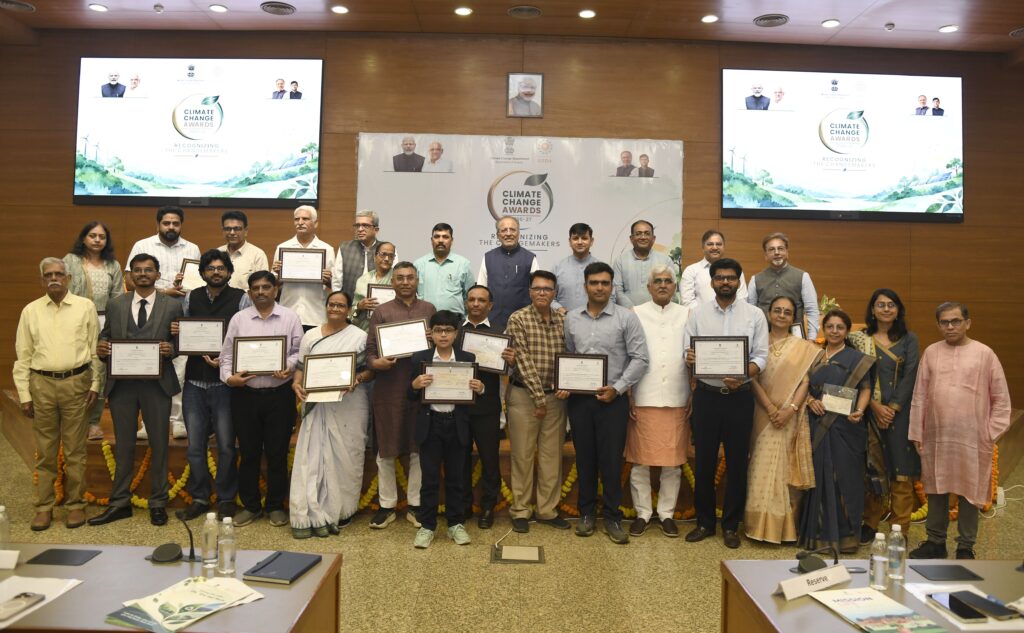
Gandhinagar, September 16: Climate Change Minister Shri Arjun Modhwadia and State Minister Shri Pravin Mali presented the ‘Climate Change Awards 2026-27’ to 14 winners from across Gujarat in five different categories at a ceremony held in Gandhinagar.
The first, second and third-place winners were honoured with cash prizes of ₹1 lakh, ₹75,000 and ₹50,000, respectively.
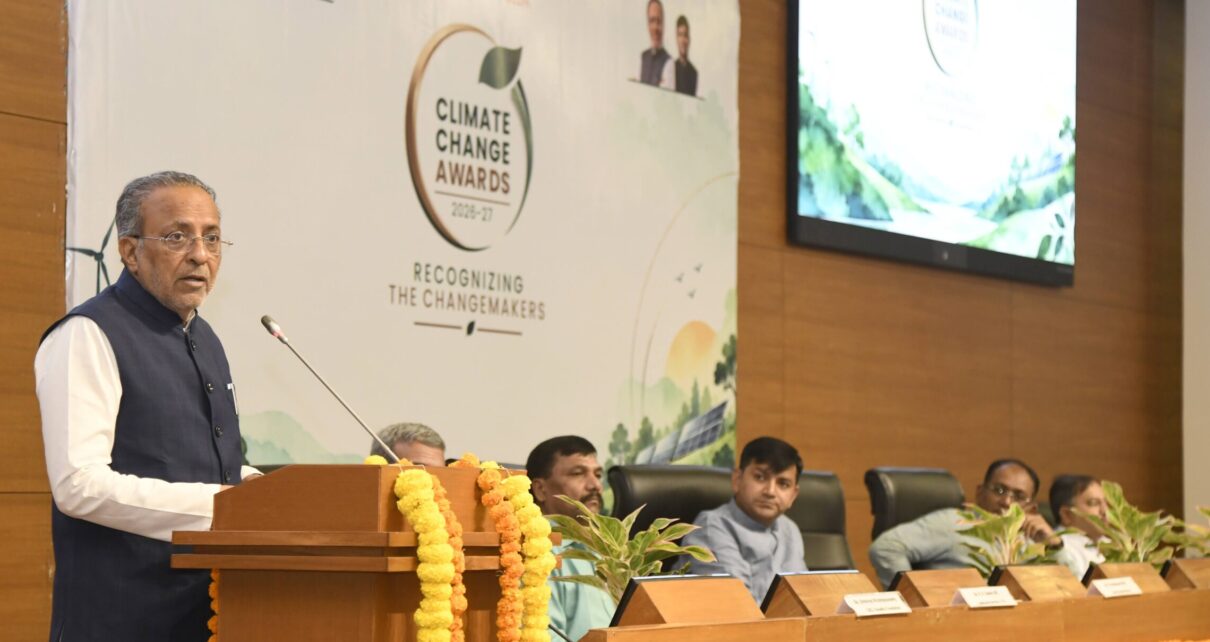
Addressing the gathering, Climate Change Minister Arjun Modhwadia said climate action must become a part of people’s “way of life” rather than remaining confined to government files and official documents.
“Climate action will remain limited to government files and papers unless it becomes a way of life. We must collectively transform it into a people’s movement,” he said.
Modhwadia recalled Gujarat’s early initiatives in the field of climate change and said the state had been among the first states in the world to establish a dedicated Climate Change Department under the leadership of then Chief Minister and Prime Minister Narendra Modi.
He highlighted the importance of increasing green cover and referred to the ‘Ek Ped Maa Ke Naam’ campaign as an example of growing public participation in environmental action. He said increasing carbon footprints and environmentally harmful activities made it essential to restore ecological balance.
“We are people who have traditionally worshipped nature. Tribal communities, too, have respected and protected nature by revering mountains, rivers, stones, trees and animals. However, our greed has increasingly gone beyond our needs,” he said.
The Minister stressed the need to educate children about climate change from an early age. He said climate education should become as fundamental as learning basic subjects and should reach beyond limited programmes in educational institutions.
He said the Climate Change Department would also need to strengthen its efforts in education and awareness to prepare the next generation for climate-related challenges.
Modhwadia said Climate Change Action Plans for around 20 districts had been prepared, covering practical measures such as shifting from LPG to PNG where appropriate, replacing diesel generators with electric alternatives, and adopting climate-conscious practices in agriculture, animal husbandry and fisheries.
He called for these findings and recommendations to be made available through simple Gujarati booklets for school and college teachers, government departments and citizens.
He further emphasised that climate action plans should not remain limited to documents but should become part of administrative reforms and government processes. Policies and government resolutions should facilitate implementation down to the taluka and district levels, he said.
The Minister also suggested incorporating one or two chapters on climate change into the curricula of primary and secondary schools as well as universities.
“We have a responsibility to leave behind a healthy environment and a liveable planet for future generations,” he said, urging stakeholders to take climate action to the grassroots level.
Pravin Mali calls for wider public participation
State Minister Pravin Mali said addressing climate change requires not only government and expert-led initiatives but also the participation of every section of society.
He said climate action should be transformed into a mass movement, adding that the number of people actively working in the climate-change field remains limited despite its vast scope.
He highlighted the contribution of institutions such as IITs, IIMs and universities in the field and said concepts such as carbon footprint, net zero and carbon neutrality need to be communicated to ordinary citizens in simple and accessible language.
Mali noted that several communities, including tribal communities, have traditionally protected nature and ecosystems through their lifestyles.
He described the decision to equip government buildings with solar power as an important step and urged greater participation from citizens and industries in the solar rooftop sector.
He also stressed the need to use simple language, micro-models and practical demonstrations to communicate climate-change issues to children and the general public.
Referring to district-level carbon-emission mapping through the Climate Action Tracker, Mali cited the agriculture sector in Banaskantha as an example and called for greater innovation to reduce emissions associated with groundwater and electricity consumption.
He urged stakeholders to connect climate action with education and create greater awareness among the younger generation while working collectively towards India’s 2070 net-zero target.
MoUs and new climate initiatives launched
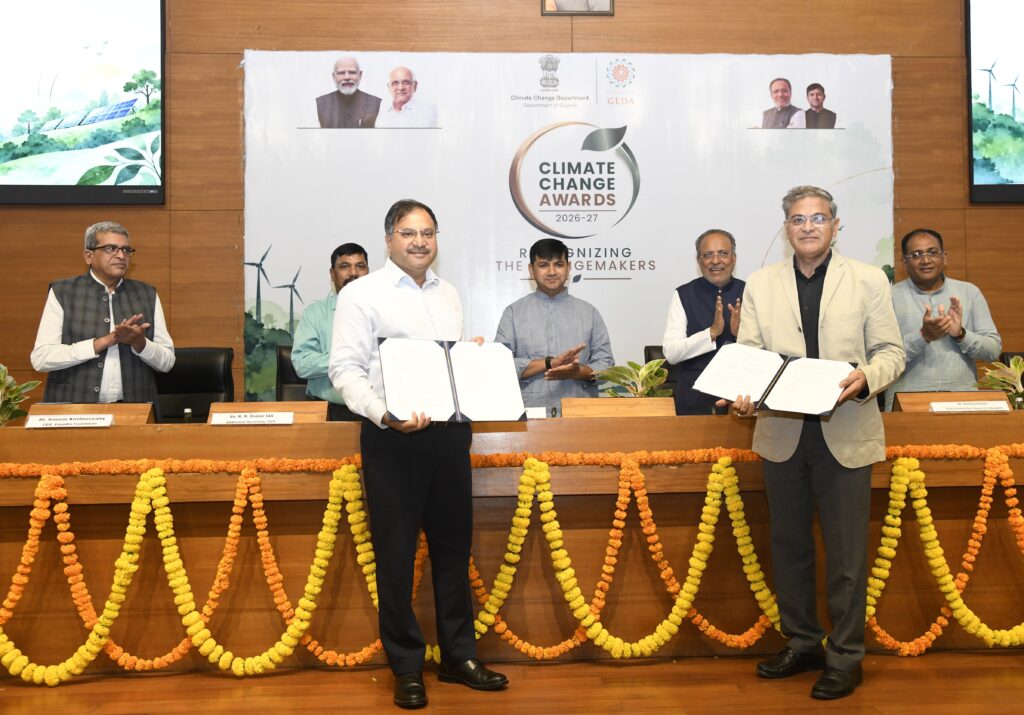
During the programme, JEDA and IIM Ahmedabad signed an MoU to promote cooperation and joint initiatives in the climate sector.
The ministers also launched the Gujarat Climate Action Tracker, Climate Change Module, and the District-Level Climate Smart Action Plan with Decarbonisation Pathway for 20 Districts.
Climate Change Awards 2026-27: Winners
The awards recognised 14 individuals and organisations for notable contributions to climate action across five categories.
Educational Institution Category
- First: Kanya Vinay Temple Sanskar Tirth, Ajol — for work in Green Technology and Sustainable Energy.
- Second: Smt. K. V. Mangukiya Vidyalaya, Jothan, Olpad, Surat — for its Green School initiatives.
- Third: Gujarat Vidyapith — for Towards a Net-Zero Future: Gujarat Vidyapith as a Climate Smart, Sustainable Campus, and Laljibhai Chaturbhai Institute of Technology, Bhandu, Mehsana — for its Integrated Sustainable Engineering Campus Model.
Individual Category
- First: Dhrumin Narottambhai Dabhi, Ahmedabad — for a scalable rural solid-waste management guideline and model-village implementation under the Swachh Bharat Mission-Gramin.
- Second: Ashokbhai Amichandbhai Patel, Himmatnagar — for work in green technology and energy efficiency at Amidhara Farm.
- Third: Ansh Nayan Shah, Vadodara — for Adopt the Plant, Adopt the Future.
Research Project Category
- Third: Dr. Ronak R. Gadhvi, Ahmedabad — for significant research and work in climate change and environmental conservation.
Public Awareness Category
- First: Swaraj Saurashtra Voluntary Action, Rajkot — for work towards improving self-reliance and resilience among rural communities in Rajkot district.
- Second: Paryavaran Mitra, Ahmedabad — for The Green Catalyst: Youth Involvement and Participation in Waste Management, Climate Change and Environmental Awareness in Gujarat.
- Third: Farmbridge Social Support Foundation, Bharuch — for Climate Change Adaptation in Agriculture through Innovative Interventions, and Shikshan and Samaj Kalyan Kendra, Amreli — for work towards improving rural community self-reliance and resilience.
Women Entrepreneur Category
- First: Ushaben M. Damor, Dahod — for Usha Van: A Woman’s Remarkable Environmental Initiative to Combat Climate Change.
- Second: Yashika Y. Rotliwala, Surat — for Home Biogas – Green Energy and Organic Fertilizer from Wet Waste.
At the beginning of the programme, JEDA Director Dharmesh Patel delivered the welcome address and provided an overview of the awards. Climate Change Department Deputy Secretary Nita Jadav proposed the vote of thanks.
Gujarat Vidyapith Vice-Chancellor Dr. Harshad Patel, Climate Change Department Additional Secretary R. R. Damor, Vasudha Foundation CEO Srinivas Krishnaswamy, senior government officials and environmental experts were also present at the event.