

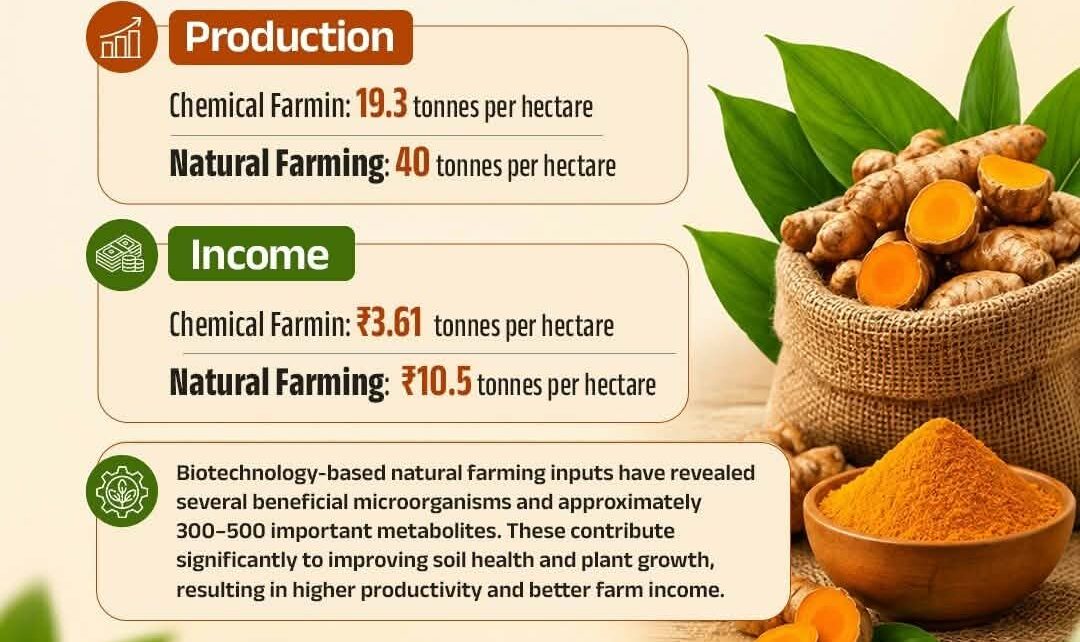
Natural farming field trials at SDAU show turmeric yields of more than 40 tonnes per hectare, compared with 19.3 tonnes under conventional farming. The economics are equally striking, with natural farming generating net returns of more than Rs 10.5 lakh per hectare, compared with approximately Rs 3.61 lakh under conventional (chemical) farming: Shri Arjun Modhwadia, Minister for Science and Technology, Gujarat.
The integration of traditional farming practices with biotechnology could help provide a stronger scientific basis for expanding low-input and environmentally sustainable agriculture in the State: Shri Arjun Modhwadia Gandhinagar: A biotechnology-backed research programme aimed at strengthening Bharatiya Prakritik Krishi Paddhati (natural farming) has reported a significant breakthrough in turmeric cultivation in Gujarat, with field trials at Sardarkrushinagar Dantiwada Agricultural University (SDAU) in a joint study conducted by Gujarat Biotechnology Research Centre and SDAU showing that turmeric grown under natural farming conditions produced nearly twice the yield recorded under conventional chemical farming. “The study, published in BMC Plant Biology in 2026, compared conventional chemical farming with nine different natural farming treatment combinations.
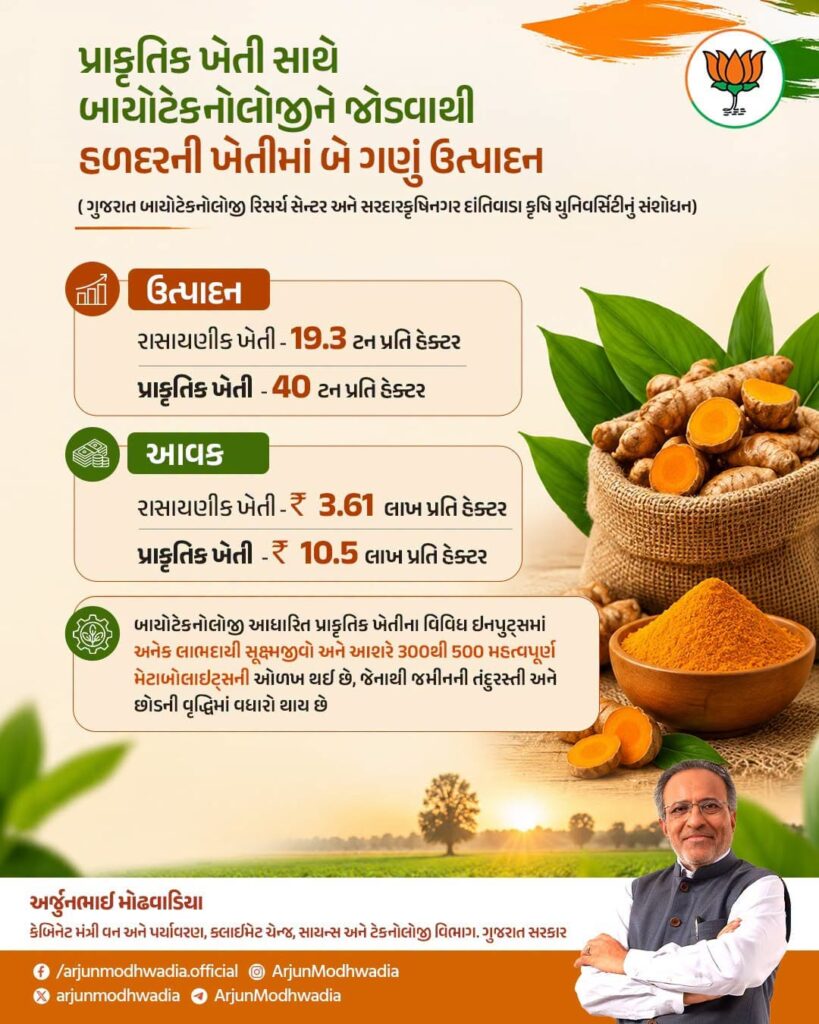
One of the natural farming treatments produced more than 40 tonnes of fresh turmeric rhizomes per hectare, compared with 19.3 tonnes per hectare under conventional farming,” said Shri Arjun Modhwadia, Minister for Science and Technology. “Turmeric, often described as the ‘golden spice’, plays a major role in India’s food, pharmaceutical and traditional medicine sectors. Its active compound, curcumin, has also driven growing demand in domestic and international markets. However, intensive cultivation dependent on chemical fertilisers and pesticides can place increasing pressure on soil ecosystems and farm economics,” Shri Arjun Modhwadia added. Prime Minister Narendra Modi has repeatedly advocated natural and chemical-free farming as a means of improving soil health, reducing farmers’ input costs and making Indian agriculture more sustainable.
Gujarat Governor Shri Acharya Devavrat has been travelling from village to village to promote a cow-based natural farming model, encouraging farmers to reduce their dependence on chemical fertilisers and pesticides. The model uses locally available inputs such as cow dung, cow urine, gram flour and jaggery to prepare microbial formulations such as Jeevamrit, which are used to enhance soil fertility and support crop growth. Under the leadership of Chief Minister Shri Bhupendra Patel , the State has made significant efforts to promote natural and low-input agriculture, with a growing focus on reducing farmers’ dependence on costly external inputs while restoring soil fertility. Combining Traditional Practices with Modern Science “The findings have emerged from a Network Research Programme on Bharatiya Prakritik Krishi Paddhati through Biotechnology Interventions, which seeks to combine traditional Indian farming practices with modern scientific tools to improve crop productivity, restore soil health and promote environmentally sustainable agriculture,” said P. Bharathi (IAS), Secretary, Department of Science and Technology, Gujarat. “The programme covers 18 crops across eight agro-climatic zones, with researchers examining how natural farming practices and biotechnology can work together to develop productive, chemical-free farming systems,” P. Bharathi added.
At SDAU in Banaskantha, researchers evaluated natural farming practices based on cow-derived bioformulations traditionally used in Indian agriculture. These included Beejamrit, used for seed treatment; Jeevamrit, applied as a liquid biostimulant; and Ghanjeevamrit, used as a solid natural farming input. The treatments were supplemented with wheat-straw mulch, which provided organic matter and helped maintain soil conditions favourable for microbial activity,”said Digvijaysinh Jadeja, Mission Director, Gujarat State Biotechnology Mission (GSBTM). “Researchers found that the turmeric crop performed substantially better under natural farming than under conventional farming, with the natural farming plots recording about twice the yield of the chemical-farming system,” Jadeja said. Seven Farmers Trained and Adopted Natural Farming The programme has also moved beyond experimental plots to assess the feasibility of transferring the practices to farmers. Following repeated trials, researchers trained farmers for natural farming input preparation and practices. After training, six farmers of Banaskantha district adopted natural farming practices for turmeric cultivation. Biotechnology Offers New Insights An important component of the programme has been the use of biotechnology to understand how natural farming inputs may influence plant growth and crop performance. “The Gujarat Biotechnology Research Centre (GBRC) carried out an in-depth microbial and metabolomic analysis of key natural farminginputs, including Beejamrit, Jeevamrit, Ghanjeevamrit, and other natural farming bioformulations used as biocontrol agents. The analysis identified several beneficial microbes and around 300 to 500 important metabolites belonging to 11 different classes, several of which could play a role in stimulating soil health, plant growth and improving crop resilience,” said Snehal Bagatharia, Director, GBRC. Search for Beneficial Microbes The biotechnology component of the programme has also focused on microbial communities associated with soils under natural farming. Scientists at the CSIR-Central Salt & Marine Chemicals Research Institute (CSIR-CSMCRI), Bhavnagar, isolated several plant-growth-promoting microorganisms from soils cultivated under natural farming practices.
These microbial resources could provide a foundation for developing natural biofertilisers and other biological inputs, potentially reducing farmers’ dependence on synthetic agricultural chemicals. The Economics Are Equally Striking The financial findings further strengthen the case for the natural farming approach. Even when cow-based inputs had to be purchased, the study reported net returns of more than Rs 10.5 lakh per hectare under natural farming, compared with approximately Rs 3.61 lakh per hectare under conventional farming. The difference reflects the combined impact of higher yields and reduced reliance on costly synthetic agricultural inputs. A Living Soil Ecosystem The study also found that natural farming encouraged beneficial microorganisms in the soil. Plant-growth-promoting bacteria, including Priestia and members of Acidobacteria, became more prominent, while beneficial saprophytic fungi such as Humicola, Mortierella and Trichoderma were also enriched. These organisms play important roles in breaking down organic matter, recycling nutrients and suppressing plant pathogens. The Gujarat findings, particularly the improvement in turmeric yields and the discovery of potentially useful microorganisms and metabolites, provide promising leads for developing a more science-driven model of natural farming. The integration of traditional farming practices with biotechnology could help provide a stronger scientific basis for expanding low-input and environmentally sustainable agriculture in the State.


