
# Conglomerate aligning investments with energy, logistics, materials and defence indigenisation.
# Leadership reset targets faster execution, AI adoption and workforce renewal.
# Sustainability and stronger communication key to long-term credibility.
New Delhi, 21 February 2026: The Adani Group is strengthening its focus on national infrastructure priorities, defence-linked ecosystems and internal governance as it navigates rapid expansion, Mr Karan Adani said on Saturday.
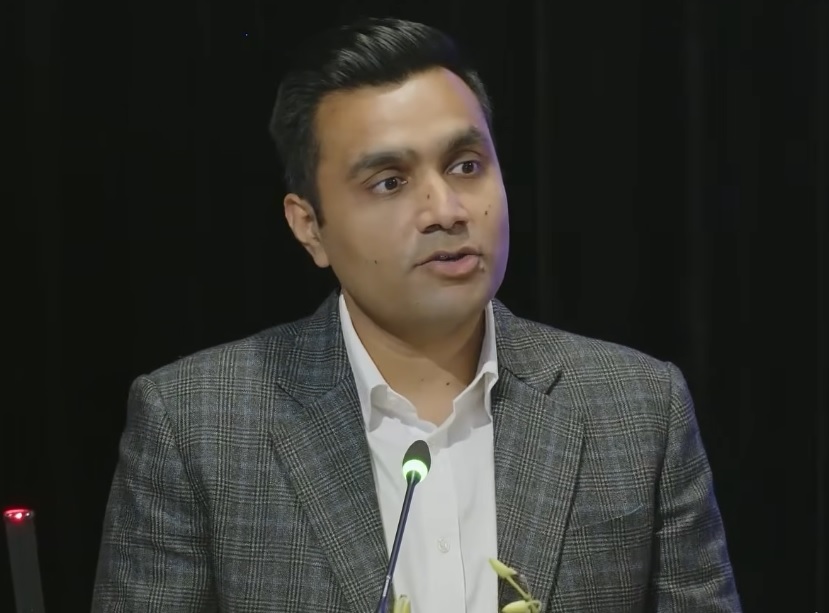
Speaking at an interaction hosted as part of the All India Management Association’s (AIMA) platinum jubilee celebrations, Mr Adani, Managing Director (MD) of Adani Ports and Special Economic Zone (APSEZ) and Director at Adani Cement, outlined the conglomerate’s evolving capital allocation strategy.
Mr Adani, the eldest son of Adani Group Chairman Mr Gautam Adani, said investments remain centred on three pillars: energy, logistics and core materials critical to India’s development. Energy infrastructure, including city gas distribution, power transmission networks and emerging digital assets such as data centres, will remain a long-term focus.
On defence participation, he said indigenisation is a strategic national objective. He pointed to maintenance, repair and overhaul (MRO) capabilities, including a recent partnership with Brazil’s Embraer, as part of a broader aviation and defence ecosystem integrating domestic manufacturing with global supply chains.
Addressing organisational challenges, Mr Adani acknowledged that rapid expansion had increased management layers, slowing decision-making. Restoring speed and scalability while reducing structural complexity is now a priority, he said.
The Group is working to lower its average employee age, currently 38, to accelerate artificial intelligence (AI) adoption. He noted that the Group’s broader $100 billion investment commitment announced this week, aimed at building renewable energy-powered infrastructure by 2036, also underpins its long-term AI and digital ambitions. Female workforce participation has risen to 15 per cent from 2 per cent earlier. Around 80 per cent of leadership has been developed internally, with mobility encouraged across ports, airports, cement and mining operations.
Responding to audience questions on governance and credibility following regulatory scrutiny and media coverage, Mr Adani said resilience depends on strong operating fundamentals and transparent communication.
He described the Group’s core infrastructure portfolio as a structural strength due to recurring revenues but acknowledged earlier concentration risks. Institutionalisation and broader partnerships are part of strengthening governance frameworks, he said.
“We also need to communicate our context better,” he said, adding that narrative-building has become increasingly important in global markets.
On sustainability, Mr Adani rejected the view that environmental measures undermine profitability. He said port operations are transitioning truck fleets from diesel to green fuel alternatives this year.
Mr Adani reiterated interest in reviving Formula One (F-1) racing in India as a platform to showcase infrastructure capability. Following the acquisition of Jaypee-related assets, including the Buddh International Circuit in Greater Noida, he said any revival would aim to set global benchmarks.
Reflecting on his early career, Mr Adani recalled working on the ground at Mundra Port without special privileges, an experience he said shaped his operational outlook more than formal education.
Mr Adani was in conversation with Sunil Kant Munjal, Chairman of Hero Enterprise and Past President of AIMA.