
Bengaluru, October 15, 2026: In a significant development in solar science, scientists have for the first time jointly analysed scientific observations of the same solar eruptions captured by India’s Aditya-L1 mission and Europe’s Proba-3 mission.
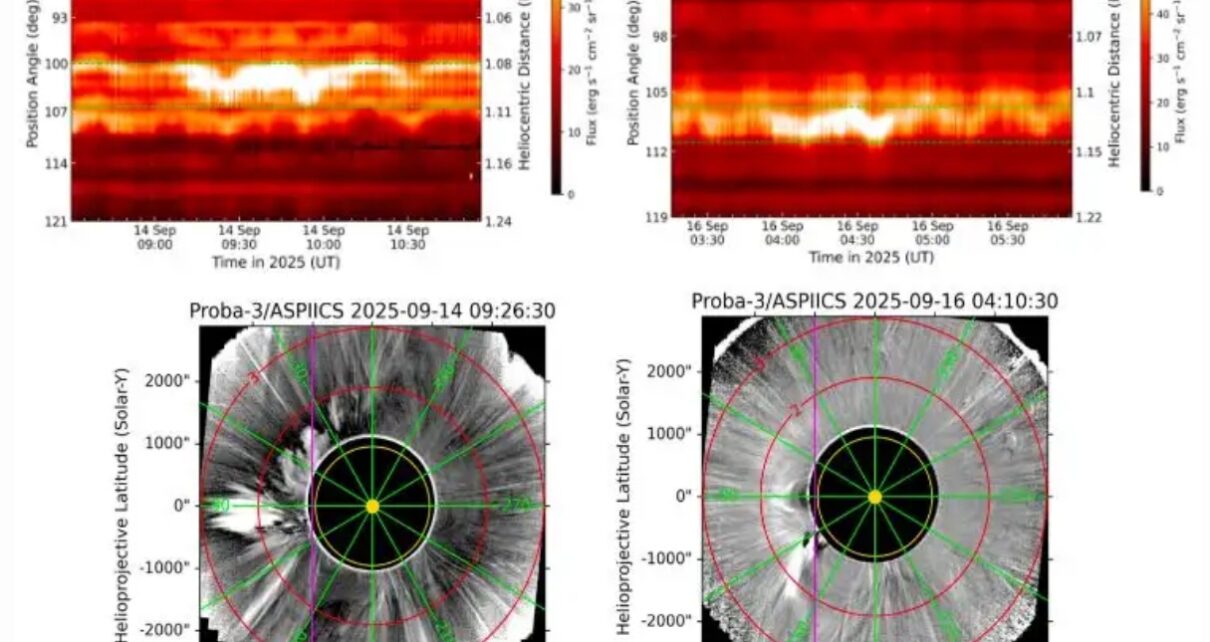
Researchers at the Indian Institute of Astrophysics (IIA), Bengaluru, combined observations from the Visible Emission Line Coronagraph (VELC) onboard Aditya-L1 and the ASPIICS coronagraph onboard Proba-3 to study coronal mass ejections (CMEs) close to the Sun.
The study, published in the prestigious journal Astronomy & Astrophysics, measured the mass, density and energetics of CMEs in the inner corona, providing new insights into how these powerful solar eruptions develop shortly after their birth.
Why the Study Matters
Coronal mass ejections are enormous eruptions from the Sun that propel huge quantities of magnetised plasma into interplanetary space. When directed towards Earth, CMEs can disturb the near-Earth space environment and affect space-based technologies and systems.
Understanding the properties of CMEs close to the Sun is particularly important because their early evolution determines how they develop as they travel through space. However, observing faint CMEs very close to the solar disk has remained challenging.
The combined observations from Aditya-L1 and Proba-3 offer scientists a more comprehensive view of CME evolution and help address uncertainties about how CME energy is distributed among kinetic, thermal and magnetic components in the inner corona.
Aditya-L1 and Proba-3 Working Together
India’s Aditya-L1, the country’s first dedicated solar mission, was launched aboard PSLV-C57 on September 2, 2023. The spacecraft was placed into a halo orbit around the Sun-Earth L1 point on January 6, 2024, providing a continuous vantage point for observing solar activity.
The VELC instrument, developed by the Indian Institute of Astrophysics in collaboration with ISRO, conducts spectroscopic observations of the solar corona between 1.05 and 1.5 solar radii, including observations in the 5303 Angstrom green coronal emission line.
Europe’s Proba-3, a European Space Agency mission, was launched aboard PSLV-XL from Sriharikota on December 5, 2024. It is the world’s first precision formation-flying mission.
The two Proba-3 spacecraft fly approximately 150 metres apart, with one spacecraft creating a shadow over the other. This produces an artificial solar eclipse in space, allowing the ASPIICS coronagraph to observe the solar corona from about 1.1 to 3 solar radii.
Two CMEs Observed Simultaneously
The VELC and ASPIICS instruments observed nearly the same region of the solar corona using different techniques. While ASPIICS provides high-resolution imaging, VELC delivers spectroscopic information about the hot CME plasma.
Between July and December 2025, only two CMEs were simultaneously observed by both instruments — on September 14 and September 16, 2025.
In both cases, VELC captured the eruptions at an early stage, demonstrating how the two instruments can complement each other in studying the initial development of CMEs.
Key Findings
The researchers found significant differences between the two observed CMEs.
- The September 14 CME travelled at approximately 645 km per second, making it the faster of the two eruptions.
- The September 16 CME was considerably slower, travelling at around 145 km per second.
- The density of the September 16 CME declined more rapidly with increasing height, suggesting stronger early expansion.
- Estimates of CME mass and thermal energy obtained independently from ASPIICS and VELC showed good agreement despite differences in observation methods and physical assumptions.
- For the September 14 CME, thermal energy accounted for only about 1% of the total energy.
- In the September 16 CME, thermal energy increased until it became comparable to the kinetic energy.
- The estimated magnetic energy was comparable to, or greater than, the kinetic energy.
New Window into Solar Activity
The findings demonstrate the scientific potential of combining imaging and spectroscopic observations to study CMEs close to their origin.
According to the study, the complementary capabilities of Aditya-L1/VELC and Proba-3/ASPIICS can help scientists better constrain CME mass, density and energy, while providing important observational evidence about their early evolution.
The research was led by scientists from the Indian Institute of Astrophysics, in collaboration with European and American solar physicists.
The study also highlights the growing scientific contribution of Aditya-L1 and the value of international cooperation in advancing solar astrophysics and space science.